
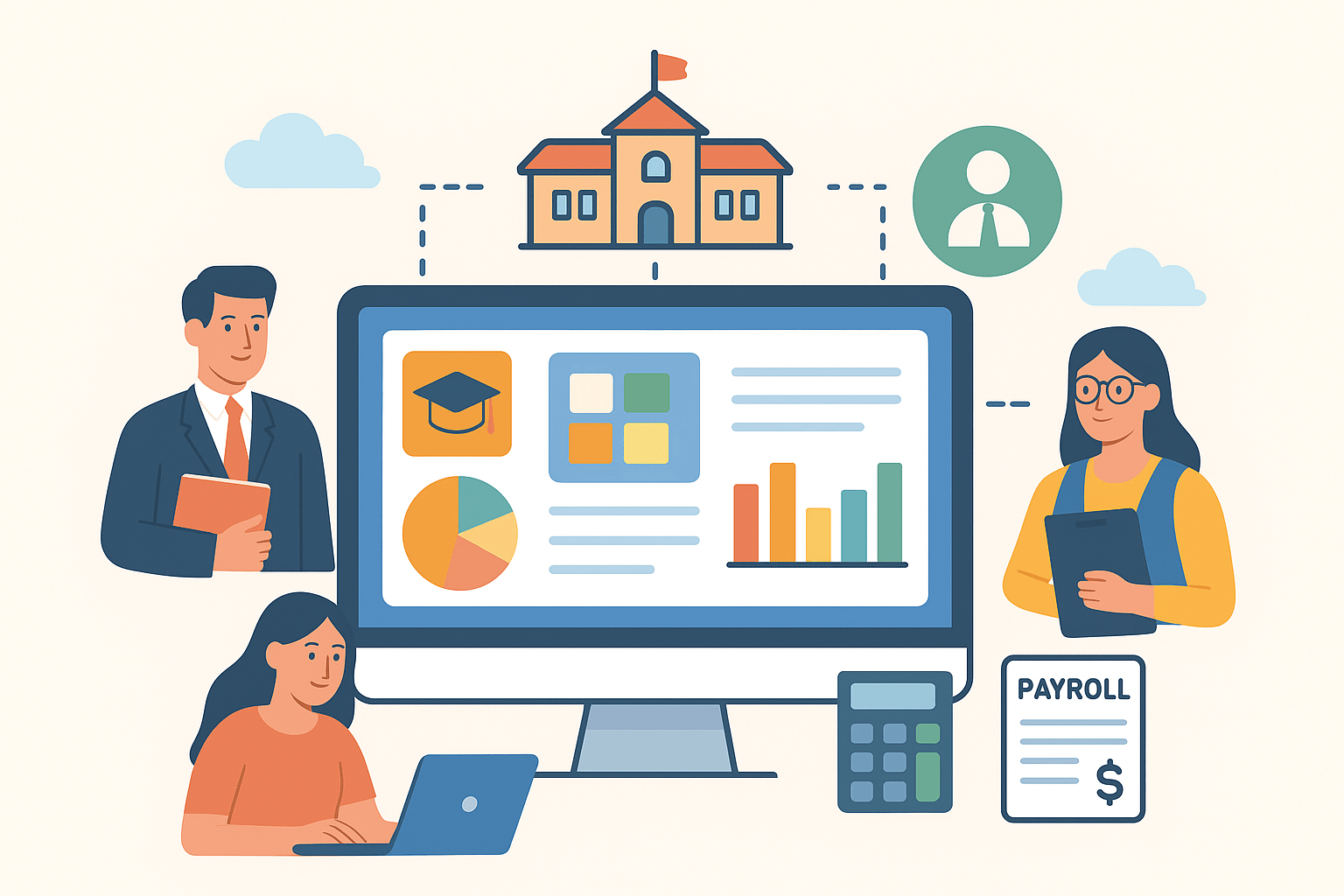
Introduction:
In today’s fast-changing educational landscape, schools and universities are under increasing pressure to modernize their operations, improve transparency, and deliver a better experience for students, parents, and staff alike. From handling admissions and academic scheduling to managing budgets, payroll, and staff performance, the administrative workload has never been more complex. Many educational institutions—especially those that have expanded over time—often find themselves juggling multiple, disconnected systems: one for finance, another for student management, yet another for HR or payroll. This fragmentation not only leads to inefficiencies and redundant data entry but also makes it difficult for school leaders to gain a holistic view of how the institution is performing.
This is where integrated ERP (Enterprise Resource Planning) systems step in. Originally designed for manufacturing and business operations, ERP systems have evolved to meet the unique needs of schools and universities. An integrated ERP brings together various functions—academic, administrative, financial, and human resources—under one unified platform. Instead of isolated silos of information, data flows seamlessly across departments, enabling real-time insights, faster decision-making, and a smoother operational experience for everyone involved.
In education, efficiency is more than just a matter of saving time or cutting costs—it’s about empowering teachers to focus on teaching, helping administrators make data-driven decisions, and ensuring that every stakeholder, from parents to policymakers, can trust the integrity of the school’s processes and data. An integrated ERP system becomes the backbone that holds all these moving parts together, creating a cohesive ecosystem where information is shared, accurate, and instantly accessible.
The Challenges of Disconnected Systems in Education
Many schools, especially those that have grown organically or operate across multiple campuses, struggle with legacy systems or manual workflows. For example, the academic department might use one software for student grades and attendance, while the accounting team works on standalone spreadsheets, and HR relies on paper-based records. These disconnected tools not only consume valuable time but also increase the risk of errors, duplicate data, and compliance issues.
Imagine a scenario where the HR department updates an employee’s contract, but payroll doesn’t receive that information in time for the next salary run. Or a situation where tuition fee data in the accounting system doesn’t match student enrollment numbers in the academic system, creating confusion during audits. Such inconsistencies can erode trust, waste hours of reconciliation work, and ultimately affect the reputation of the institution.
Moreover, the lack of integration makes it difficult to generate comprehensive reports. A school principal or financial controller who wants to understand the overall cost per student, the correlation between staff workload and academic performance, or the budget utilization rate might have to manually pull data from different systems—an exhausting and error-prone process.
An integrated ERP system solves these issues by creating a single source of truth. Every department, from admissions to payroll, accesses and updates the same centralized database. This synchronization ensures accuracy, reduces redundant work, and allows leadership to monitor key metrics instantly. Instead of spending time fixing data inconsistencies, teams can focus on improving educational outcomes.
Why Integration Matters: Connecting Education, Accounting, HR, and Payroll
Integration is the heartbeat of an effective ERP system. In a school environment, it’s what turns a collection of departments into a well-coordinated organism. When systems communicate seamlessly, the benefits multiply across every corner of the institution.
1. Education and Accounting Integration:
At the core of any school’s operations lies the management of student fees, expenses, and budgets. Integrating educational processes with accounting ensures that every financial transaction—from tuition payments to procurement—is automatically reflected in the general ledger. This reduces manual entry, prevents revenue leakage, and makes financial tracking more transparent. For instance, when a student enrolls and pays their fees, the accounting system instantly records the payment, updates the student’s financial status, and generates a receipt—all without human intervention. Likewise, any scholarship, discount, or refund is processed smoothly, maintaining a clear audit trail.
2. Education and HR Integration:
Teachers and staff are the backbone of every educational institution. By connecting academic data with HR systems, administrators can easily align human resources with academic needs. For example, when new classes are created, the ERP can automatically assign teachers based on workload, availability, and expertise. Attendance tracking can also feed directly into HR performance records, allowing for fair evaluations and targeted professional development programs.
3. HR and Payroll Integration:
Payroll is one of the most sensitive and time-consuming areas in school administration. When HR and payroll systems operate separately, it often leads to errors and frustration. Integrated ERP systems eliminate these issues by automatically syncing employee data—such as attendance, leave balances, and contract terms—directly into payroll calculations. This ensures that salaries, deductions, and bonuses are processed accurately every time. Moreover, compliance with labor laws, taxation, and reporting standards becomes much easier when everything is unified under one digital roof.
Ultimately, integration across education, accounting, HR, and payroll enables schools to move away from reactive management and toward proactive decision-making. Administrators can forecast budgets, track academic and operational performance in real time, and allocate resources more strategically.
How School Next Delivers a Unified ERP Experience for Schools
While the concept of ERP integration is powerful, the real impact comes from implementation—and that’s where School Next stands out. Designed specifically for educational institutions, School Next brings together the best practices of enterprise-grade ERP systems and tailors them to the unique workflows of schools, academies, and training centers.
School Next provides a fully integrated ecosystem that connects academics, finance, human resources, and communication in one user-friendly platform. Unlike generic ERP systems that require heavy customization, School Next understands the everyday realities of running a school—managing students, coordinating staff, ensuring financial accuracy, and maintaining compliance with educational regulations.
Some of the core strengths of School Next include:
- Centralized Data and Workflow Automation:
Every transaction, record, and report originates from a single, shared database. Whether it’s a student’s academic progress, a staff member’s payroll, or a budget report for the school board, all information is interconnected and instantly available. - Customizable Academic Modules:
From admissions and scheduling to attendance and grading, School Next’s academic management tools streamline daily operations and make administrative tasks faster and more accurate. Integration with accounting ensures that fee collection, refunds, and scholarships are automatically synchronized with financial records. - Smart HR and Payroll Integration:
School Next bridges HR with payroll seamlessly, automating calculations for salaries, taxes, and benefits. Leave approvals and attendance records feed directly into payroll, reducing human errors and administrative delays. - Real-Time Reporting and Analytics:
With integrated dashboards and reporting tools, decision-makers can track the school’s financial health, academic performance, and HR efficiency at a glance. These insights help identify trends, allocate resources wisely, and plan for long-term growth. - Scalability and Cloud-Based Access:
Whether managing a single campus or multiple branches, School Next’s scalable architecture allows institutions to grow without disrupting existing operations. Being cloud-based, it ensures secure, real-time access from anywhere, empowering administrators and teachers to stay connected beyond office hours.
In essence, School Next does more than just digitize operations—it transforms how educational institutions think about management. By integrating all critical departments into one intelligent platform, it replaces complexity with clarity, manual effort with automation, and fragmentation with unity.
The Broader Impact of ERP Integration on Education
As technology continues to reshape education, integrated ERP systems are becoming a strategic necessity rather than a luxury. Schools that adopt comprehensive digital platforms position themselves for long-term success—not only by saving time and money but by creating a culture of transparency, accountability, and continuous improvement.
With integrated systems like School Next, institutions gain the agility to respond quickly to new challenges—whether it’s scaling up enrollment, adapting to hybrid learning models, or meeting government reporting standards. Teachers benefit from reduced administrative burden, parents enjoy smoother communication, and students experience a more organized and responsive academic environment.
Ultimately, an integrated ERP system is not just about managing data—it’s about managing relationships: between students and teachers, administrators and staff, schools and parents. By connecting every part of the organization, ERP technology empowers educational institutions to focus on their true mission—delivering quality education efficiently and sustainably.
Integration Between Education, Accounting, HR, and Payroll
Integration is the defining feature of a modern ERP system—and in education, it is the bridge that transforms administrative complexity into operational harmony. While schools and universities have traditionally managed departments independently, this siloed approach is no longer practical in today’s data-driven world. The integration between education, accounting, HR, and payroll creates a digital ecosystem where all departments communicate in real time, ensuring accuracy, speed, and transparency across every layer of the institution.
When each function operates in isolation, data duplication, inconsistencies, and inefficiencies inevitably arise. A change in one department might go unnoticed in another, leading to avoidable errors—such as salary discrepancies, budget overruns, or missing student records. By contrast, an integrated ERP system connects these functions through a unified database. Any update made in one module is instantly reflected across all others. This is the foundation of a truly efficient, technology-driven school management process.
Let’s break down how this integration works in practice and why it matters for educational institutions of all sizes.
1. Integration Between Education and Accounting
The relationship between the educational process and accounting operations is more intertwined than many realize. Every academic activity has a financial implication: student enrollment affects tuition revenue; class scheduling influences resource allocation; extracurricular programs generate expenses. When education and accounting systems operate independently, these connections become blurred, resulting in fragmented data and financial ambiguity.
An integrated ERP system ensures that academic and financial data move hand in hand. Here’s how this integration enhances efficiency and control:
a. Automated Fee Management
Traditionally, schools handle tuition payments through manual processes—issuing invoices, updating ledgers, and reconciling payments. This is time-consuming and prone to human error. In an integrated ERP system, the student management and accounting modules are fully synchronized. When a student is enrolled, their financial record is automatically created, linking tuition, transportation, library fees, and other charges. Once payment is made, the accounting module updates in real time, reflecting the transaction in the school’s general ledger and generating an instant digital receipt. This not only saves hours of administrative work but also eliminates discrepancies between student and financial records.
b. Transparent Revenue Tracking
Schools often offer multiple programs—day classes, after-school activities, special courses, and events. Each of these generates revenue streams that must be tracked separately. Integration allows for clear visibility into where income originates and how it aligns with expenses. For example, administrators can analyze profitability per program or monitor how scholarship allocations affect total revenue without manually consolidating data from different systems.
c. Expense and Budget Alignment
Budget planning is one of the biggest challenges in education. Without integration, academic departments may make spending decisions without visibility into the overall financial situation. Integration ensures that budget requests, procurement, and expenditures automatically sync with the accounting module. When a department purchases supplies or books, the expense is immediately reflected in the budget dashboard. This real-time tracking prevents overspending and supports more strategic financial planning.
d. Simplified Auditing and Compliance
Auditing becomes far easier when financial and academic data are stored within the same system. Every transaction is traceable—from a student’s payment to its corresponding accounting entry—ensuring compliance with internal policies and external regulations. During audits, schools can generate detailed reports instantly, reducing stress and saving days of preparation.
In essence, the integration of education and accounting transforms the school’s financial management from a reactive, paper-based task into a proactive, data-driven process. Administrators gain real-time financial visibility, enabling smarter decisions and stronger accountability.
2. Integration Between Education and HR
A school’s success depends on its people—teachers, administrators, and support staff. Managing human resources in isolation from academic planning leads to inefficiencies such as unbalanced workloads, scheduling conflicts, or mismatched staffing levels. Integrating education and HR ensures that human capital aligns seamlessly with academic needs.
a. Teacher Allocation and Workload Balancing
When class schedules are created, the ERP automatically checks available teachers, their subjects, and current workloads. Instead of manually coordinating assignments, the system can suggest optimized schedules, ensuring that no teacher is overbooked and every class has the right expertise. For example, if a new course is introduced mid-semester, the HR module immediately identifies qualified staff based on their profiles and availability, streamlining the hiring or reassignment process.
b. Professional Development and Performance Evaluation
Integration allows HR departments to track teacher performance using academic data such as student feedback, attendance rates, and exam results. This connection supports evidence-based evaluations and identifies areas for professional growth. A teacher who consistently manages high-performing classes may be recognized and rewarded, while another struggling with attendance issues can receive targeted training or mentoring.
c. Recruitment and Onboarding Automation
When schools expand or new academic programs are launched, hiring becomes critical. Integration ensures that job postings, candidate tracking, and onboarding processes are all linked to academic requirements. Once a new teacher is hired, their HR profile—including contract details, qualifications, and salary structure—feeds directly into the academic and payroll systems. This eliminates repetitive data entry and ensures that new employees are ready to begin teaching without administrative delays.
d. Attendance and Leave Synchronization
Teacher and staff attendance directly affects academic scheduling and payroll. Integration means that absences are automatically reflected in class schedules and salary calculations. If a teacher takes leave, the ERP system can notify the academic coordinator to arrange a substitute, ensuring minimal disruption to classes. This real-time coordination keeps academic operations smooth and predictable.
By connecting HR with educational management, schools create an environment where staffing decisions are data-driven, responsive, and aligned with strategic goals. This not only boosts productivity but also enhances job satisfaction and overall institutional effectiveness.
3. Integration Between HR and Payroll
Payroll is the financial reflection of HR operations. When these two functions are disconnected, salary errors, delayed payments, and compliance risks can quickly arise. In an integrated ERP system, HR and payroll work as two sides of the same coin—sharing a single database that automatically processes employee information from hiring to payment.
a. Real-Time Data Flow
When HR updates an employee’s details—such as a contract change, promotion, or new benefits—the payroll module instantly adjusts corresponding calculations. There’s no need to manually transfer data or re-enter numbers. This ensures that every salary run is accurate, up to date, and consistent with HR records.
b. Automated Salary Calculations
Payroll processing involves multiple variables: attendance, overtime, deductions, taxes, and allowances. In a disconnected system, these elements are often calculated manually or through spreadsheets. Integration automates the entire process. Attendance data from the HR module feeds directly into payroll, ensuring that each employee is paid precisely for their hours worked. Any approved leave or bonus updates automatically reflect in the next payroll cycle.
c. Compliance and Reporting
Labor laws, taxation, and social insurance regulations require meticulous record-keeping. Integrated systems simplify compliance by generating accurate reports for government submissions. Administrators can access detailed breakdowns of salaries, deductions, and benefits in seconds. This not only saves time but also ensures the institution avoids costly penalties.
d. Transparency and Employee Empowerment
Through self-service portals, teachers and staff can view their payslips, tax information, and leave balances without needing to contact HR. This transparency builds trust and reduces administrative workload. Employees appreciate having direct access to their information, while HR teams can focus on more strategic initiatives.
When HR and payroll integration is fully implemented, the school’s administrative rhythm becomes smoother, faster, and more reliable. Errors are minimized, compliance is ensured, and staff morale improves through consistent, on-time payments.
4. The Power of Complete Cross-Department Integration
While each of these integrations—education with accounting, education with HR, and HR with payroll—brings its own advantages, the real transformation happens when all four functions operate as one ecosystem.
Imagine this: a student enrolls in a new semester. The ERP automatically generates an invoice in the accounting module, updates the academic roster, and adjusts the teacher workload in the HR module. The new teacher’s salary, linked to their teaching hours, is automatically calculated in the payroll system. No redundant data entry. No communication gaps. Every department operates from the same, synchronized source of truth.
This level of connectivity unlocks a series of tangible benefits:
a. Data Accuracy and Elimination of Redundancy
Integration removes the need for manual synchronization between systems. The same student or employee record is used across all modules, ensuring consistency and reducing errors. Any change—such as a student withdrawal or staff promotion—is instantly updated everywhere.
b. Faster Decision-Making
With all departments sharing real-time data, administrators gain full visibility into academic performance, financial status, and HR metrics. Dashboards and analytics provide actionable insights—such as identifying cost inefficiencies, monitoring teacher productivity, or predicting enrollment trends.
c. Enhanced Collaboration
When departments have access to the same information, teamwork improves. The finance team can plan budgets based on accurate enrollment data; HR can allocate resources based on academic schedules; and academic leaders can forecast class sizes with financial implications in mind. Integration encourages a culture of collaboration rather than competition between departments.
d. Improved Parent and Student Experience
Integration extends beyond internal operations—it directly affects how students and parents interact with the institution. Online portals can show real-time tuition balances, class schedules, attendance records, and even teacher feedback. Payment confirmations, fee receipts, and academic updates are automated, enhancing transparency and satisfaction.
e. Strategic Growth and Scalability
As schools expand, the administrative complexity increases. Integrated systems scale effortlessly, handling additional students, teachers, and campuses without losing control over data integrity. Leadership can replicate successful models across branches with consistency and ease.
5. A Foundation for Digital Transformation in Education
Integration is more than a technical upgrade—it’s a strategic foundation for digital transformation. In the coming years, educational institutions that leverage integrated ERP systems will stand out for their agility, efficiency, and ability to provide superior educational services.
When schools have accurate, connected data, they can engage in advanced analytics, such as identifying correlations between financial investment and academic performance or predicting future enrollment based on demographic trends. This empowers leaders to make evidence-based decisions, ensuring that every dollar spent contributes directly to educational excellence.
Moreover, integrated systems create a culture of accountability. Teachers and administrators work from shared, transparent data sets, reducing miscommunication and reinforcing a sense of unity around institutional goals.
In short, integration between education, accounting, HR, and payroll is not just an operational convenience—it is a transformative force that modernizes how schools function, manage resources, and deliver value to students.
Highlighting School Next: A Unified ERP Solution for Modern Schools
As educational institutions evolve to meet the demands of a digital-first world, efficiency, transparency, and flexibility have become more than administrative goals—they are strategic imperatives. The days when schools could operate on manual processes or fragmented software systems are long gone. Today’s educational leaders understand that managing learning outcomes is inseparable from managing people, finances, and operations effectively.
This realization has given rise to integrated ERP systems specifically designed for the education sector, and among these, School Next stands out as a comprehensive, intelligent, and fully scalable solution built to meet the unique challenges schools face.
School Next isn’t just another ERP platform—it’s a unified ecosystem that connects every aspect of school life, from academic planning to accounting, HR, payroll, and even communication with parents and students. Built with deep domain understanding and modern cloud technology, it empowers educational institutions to operate with precision, insight, and agility.
Let’s explore how School Next redefines school management through true integration and why it’s becoming a preferred solution for forward-thinking schools.
1. The Vision Behind School Next
The idea behind School Next was born from a simple yet powerful observation: most schools struggle not because of poor management, but because of disconnected systems. Administrators often use one software for academics, another for finances, and several spreadsheets for HR and payroll. This scattered approach leads to data duplication, inefficiency, and stress.
School Next was developed to end that fragmentation. It unites every department within a single ERP platform—eliminating silos and enabling seamless communication between academic, financial, and administrative processes. The goal isn’t just to digitize operations but to transform them into a connected, intelligent workflow where information flows effortlessly, decisions are made faster, and educators can focus on what matters most: teaching and learning.
What makes School Next particularly compelling is its adaptability. Whether a small private school or a large multi-campus institution, it provides tools that can scale and evolve with the organization’s needs. Its architecture is built on the belief that a school’s management system should grow alongside its vision, not limit it.
2. The Core Pillars of School Next Integration
School Next achieves its power through deep integration between four key functional areas: Education, Accounting, HR, and Payroll.
Each area is fully developed yet designed to operate in harmony with the others, creating a unified experience for administrators, teachers, and staff.
a. Education Management
At the heart of School Next lies its robust academic management module. This isn’t a simple digital gradebook—it’s a full ecosystem that handles every aspect of the student lifecycle.
From the moment a student applies for admission, the system tracks their journey through enrollment, class allocation, attendance, grading, and graduation. Academic calendars, subjects, and timetables are all configurable, and every action is linked to the relevant department automatically.
For example:
- When a student enrolls, their financial record in the accounting module is created automatically.
- When they’re assigned to a class, the teacher’s workload in the HR module adjusts accordingly.
- When fees are paid or scholarships applied, those details update in both the student’s profile and the school’s general ledger instantly.
This real-time synchronization saves hours of manual coordination and ensures that all stakeholders are always working with accurate, up-to-date information.
In addition, School Next provides advanced analytics for academic tracking. Administrators can monitor student performance trends, identify at-risk students early, and even analyze how teacher workloads correlate with academic outcomes—all within a single dashboard.
b. Accounting and Financial Management
Finances are the lifeblood of any institution, and School Next treats financial management with the rigor and flexibility of an enterprise-level ERP system.
The accounting module offers full double-entry bookkeeping, budget management, expense tracking, and automated fee reconciliation—all deeply integrated with the academic side.
Each financial transaction, whether it’s tuition income or operational expense, is automatically linked to the relevant student, department, or program.
Key advantages include:
- Automated Fee Processing: Student fees are generated based on class assignments, scholarships, and discounts. Payments made through the school portal are instantly reflected in the accounting ledger.
- Budget and Expense Alignment: Departments can request funds or submit purchase orders within the system, and all expenses are tracked in real time against the approved budget.
- Simplified Auditing: Every transaction has a digital trail. Auditors can easily trace entries back to their source, significantly reducing the time spent during financial reviews.
- Financial Transparency: School leaders have access to dashboards that display revenue, expenditures, and profitability per department or program—helping them make strategic, data-driven financial decisions.
School Next not only simplifies day-to-day financial tasks but also strengthens the financial foundation of the institution through accuracy, automation, and accountability.
c. Human Resources Management
The HR module in School Next is designed specifically for educational institutions, where managing teachers and staff requires more nuance than in typical corporate environments. It centralizes all HR operations—from recruitment and onboarding to attendance, performance evaluation, and benefits management—while maintaining a direct link with both the academic and payroll modules.
Here’s how integration comes to life:
- When a new teacher is hired, their profile—including qualifications, subjects taught, and contract type—is automatically connected to academic scheduling.
- Attendance data captured daily is reflected in both HR records and payroll calculations.
- Performance evaluations can be tied to real academic outcomes such as class performance or student feedback.
With School Next, administrators can easily manage teaching loads, ensure fair evaluations, and plan staffing needs based on actual academic requirements. The system supports multi-campus operations, allowing HR managers to view and coordinate staff data across all locations with ease.
d. Payroll and Compensation
Payroll is often one of the most time-consuming and error-prone areas in school administration. School Next automates this process end to end.
Using real-time data from the HR module—attendance, leave, allowances, and deductions—the payroll system calculates salaries automatically, generates payslips, and ensures compliance with tax and labor regulations. Any change in HR data (such as a promotion, bonus, or new contract) instantly updates payroll computations.
The benefits of this integration are significant:
- Zero Manual Data Transfer: Payroll always reflects the latest HR and attendance records.
- Error-Free Salary Runs: Automated calculations ensure precision, reducing disputes and delays.
- Regulatory Compliance: Built-in tax and labor law parameters help schools stay compliant effortlessly.
- Employee Transparency: Staff can access their payslips and tax details anytime via self-service portals, promoting trust and reducing administrative inquiries.
Together, HR and payroll integration streamlines the entire employee management process—saving time, ensuring accuracy, and boosting morale.
3. Real-Time Insights Through Unified Data
One of the most powerful outcomes of using School Next is data visibility. Because every department operates within the same system, administrators gain a complete, real-time picture of school operations.
With built-in dashboards and customizable reports, School Next transforms raw data into meaningful insights. For example:
- Financial reports can instantly show fee collection trends, outstanding dues, and cash flow projections.
- Academic analytics can highlight which subjects or classes need attention.
- HR reports can reveal patterns in teacher attendance or retention rates.
This level of visibility enables proactive management. Instead of reacting to problems after they occur, decision-makers can spot trends early and take preventive action—whether it’s reallocating funds, adjusting schedules, or planning new staff training programs.
School Next’s analytics go beyond operational metrics—it supports strategic foresight. By combining financial, academic, and HR data, schools can measure how resource allocation affects learning outcomes, ultimately guiding long-term policy and growth.
4. User Experience and Accessibility
One of the biggest challenges with traditional ERP systems is usability. Many are powerful but overly complex, requiring extensive training and technical expertise. School Next takes a different approach: simplicity and accessibility without compromising capability.
Its clean, intuitive interface allows staff to navigate effortlessly, reducing learning time and boosting adoption. Teachers can take attendance, view schedules, and submit grades within seconds. Administrators can generate financial reports or approve leave requests from a single dashboard. Parents can access fee statements and student progress online through secure portals.
Moreover, School Next is cloud-based, ensuring that users can access the system anytime, anywhere—from desktops, tablets, or mobile devices. This flexibility is particularly valuable for multi-campus institutions or hybrid learning environments, where accessibility and continuity are essential.
Security is also central to the School Next experience. Data encryption, role-based permissions, and secure cloud hosting protect sensitive information while allowing appropriate access for each user type.
5. Automation and Workflow Optimization
School Next eliminates manual bottlenecks through intelligent automation. Repetitive administrative tasks—such as invoice generation, salary processing, or leave approval—are automated using predefined workflows.
For example:
- Once a parent pays tuition, the system automatically generates a receipt, updates accounting records, and sends confirmation via email or SMS.
- When an employee requests leave, the approval chain is triggered automatically, updating both HR and payroll upon final confirmation.
- Periodic reports (like attendance summaries or financial statements) can be scheduled to run automatically and delivered to administrators’ inboxes.
This level of automation reduces administrative burden dramatically and ensures consistency across all processes. Schools can reallocate staff time from routine data entry to strategic planning and student engagement.
6. Scalability and Customization
Every school is different in its structure, culture, and workflow. That’s why School Next was built with scalability and customization at its core.
It can support:
- Small private schools with a few hundred students
- Multi-campus institutions with thousands of enrollees
- Training centers, academies, or even higher education entities
Modules can be activated or deactivated based on institutional needs, and workflows can be tailored without complicated coding. As the school grows, School Next grows with it—adding new campuses, departments, or features without disruption.
For organizations that operate across regions or countries, the system can handle multiple currencies, languages, and taxation frameworks—making it a versatile global solution.
7. The Measurable Impact of School Next Integration
Schools using School Next consistently report measurable improvements across several key performance indicators:
- Administrative efficiency: Tasks that once took days now take minutes.
- Data accuracy: Errors caused by duplicate or inconsistent entries are virtually eliminated.
- Financial clarity: Real-time visibility into revenue and expenses supports better budgeting and forecasting.
- Employee satisfaction: Streamlined payroll and transparent HR processes improve morale.
- Parent engagement: Online access to payments and student updates enhances trust and communication.
In short, School Next converts complexity into clarity. It replaces disconnected workflows with a unified rhythm—one that allows educators, accountants, and administrators to operate as one cohesive team.
8. Building the Future of Smart Education
Education is entering a new era—one defined by technology, connectivity, and intelligent data use. In this landscape, ERP systems like School Next are not optional luxuries; they are essential infrastructure for growth and sustainability.
By integrating education, accounting, HR, and payroll into one cohesive system, School Next lays the foundation for smart education management. It doesn’t just streamline operations—it empowers schools to make better decisions, foster transparency, and allocate resources where they matter most.
Ultimately, School Next is more than software. It’s a partner in transformation—a tool that helps schools move confidently into the future, equipped with the insights and agility they need to deliver exceptional education.
In an era where efficiency and excellence must coexist, School Next stands as a bridge between technology and purpose—turning everyday school management into a seamless, data-driven experience that benefits administrators, teachers, parents, and, above all, students.
Integration Between Education, Accounting, HR, and Payroll in Schools and Educational Institutions
In the fast-paced world of modern education, schools and universities are no longer just learning hubs — they’ve become complex organizations that manage academic programs, staff, finances, operations, and compliance all at once. With multiple departments handling different aspects of daily management, it’s easy for inefficiencies and data silos to appear. This is where an integrated ERP system becomes essential. By seamlessly connecting education management, accounting, HR, and payroll functions, an ERP transforms a school into a cohesive, data-driven organization capable of responding quickly and intelligently to challenges.
1. The Challenge of Fragmented Systems
In many educational institutions, departments operate in isolation. The academic office maintains student records, grades, and class schedules; the finance department manages tuition fees, budgets, and expenses; the HR department oversees recruitment and staff performance; and the payroll team handles salary calculations and compliance. Each of these units may use its own software, spreadsheets, or even manual systems.
While this might seem manageable for a small school, the lack of integration often leads to major problems:
- Duplicate data entry: The same staff or student information gets entered multiple times across systems, increasing errors.
- Data inconsistency: Updates in one department (e.g., a teacher’s new contract) don’t automatically reflect in another (like payroll or accounting).
- Slow decision-making: Administrators can’t easily get a real-time overview of finances, staffing, and academic operations.
- Compliance risks: Disconnected data increases the risk of mistakes in financial reporting, tax filings, or labor law compliance.
The result is wasted time, frustrated staff, and less focus on what truly matters: student success.
2. The Power of Integration in ERP Systems
An integrated ERP system connects every operational area within a single digital platform. It acts as the central nervous system of the institution — where data flows automatically between education, accounting, HR, and payroll modules.
Let’s look at how this integration works in practice and why it’s so transformative.
a. Education and Accounting: A Transparent Financial Flow
One of the most critical connections in any school is between the academic and finance departments. Every course, program, and student enrollment has financial implications. An integrated ERP ensures that the financial side of education runs smoothly and transparently.
For example:
- When a student registers for a course or a semester, the system automatically generates an invoice based on the institution’s fee structure.
- Payments are tracked in real time, and outstanding balances are visible to both the finance team and academic administrators.
- Discounts, scholarships, and financial aid are directly linked to student profiles, ensuring accurate reporting and reconciliation.
This eliminates manual coordination between departments and prevents billing errors. It also gives decision-makers a clear picture of revenue streams, helping them plan budgets with confidence.
Furthermore, an ERP can integrate with banks and online payment gateways, allowing parents or students to pay fees online and have those transactions instantly reflected in the accounting system. This level of automation not only saves administrative effort but also enhances the parent and student experience by providing transparency and convenience.
b. Education and HR: Managing Faculty and Staff Effectively
Teachers and administrative staff are at the heart of every educational institution. Efficiently managing them — from hiring and onboarding to evaluation and professional development — is a major challenge, especially in schools with large staff bases.
An integrated ERP connects academic operations with human resources management. This connection allows:
- Automatic linking of teachers to their classes, subjects, and schedules.
- Centralized tracking of attendance, leaves, and workload.
- Performance evaluations tied directly to academic outcomes and student feedback.
For instance, if a teacher’s workload increases due to new classes being added, HR can immediately see the change, review compensation adjustments, and ensure fairness in workload distribution. Similarly, when HR updates a staff member’s profile — such as a promotion or contract renewal — the academic module automatically reflects those changes in teaching assignments and scheduling.
This synergy between HR and education modules promotes better staff planning, reduces administrative overhead, and helps maintain high teaching standards.
c. HR and Payroll: Seamless Employee Compensation
Payroll management is one of the most time-sensitive and compliance-heavy tasks in any organization. For schools, the challenge intensifies because of diverse employment types — full-time teachers, part-time tutors, hourly administrative workers, and sometimes visiting lecturers or contract-based staff.
An integrated ERP connects the HR and payroll modules to ensure that salary calculations are always accurate, compliant, and timely. Here’s how it works:
- HR data such as attendance, leaves, and overtime automatically flows into the payroll system.
- The payroll module applies the correct salary structure, deductions, taxes, and benefits.
- Payslips and reports are generated automatically and can be shared digitally with staff.
The system also handles complex scenarios like:
- Multiple pay grades and contract types.
- Automatic calculation of deductions for late attendance or unpaid leaves.
- Integration with accounting for posting salary expenses and statutory payments.
With integration, schools avoid errors that commonly arise from manual payroll processing. Moreover, it gives HR the ability to focus on employee engagement and development instead of administrative paperwork.
d. Accounting and Payroll: Unified Financial Oversight
Accounting and payroll are naturally interconnected, but when managed on separate systems, reconciliation can become a nightmare. An integrated ERP links payroll transactions directly to the accounting module.
Every salary payment, tax deduction, or benefit expense automatically generates journal entries in the institution’s books. This ensures:
- Accurate financial reporting without manual input.
- Faster month-end closings since payroll data flows directly into accounting.
- Audit readiness, as every transaction can be traced back to the source.
This unified approach enables finance teams to monitor real-time expenses, plan budgets accurately, and maintain compliance with local tax regulations. It also supports transparency — a critical value for educational institutions that often operate with public or community trust.
3. Benefits of Full Integration Across the Institution
When education, accounting, HR, and payroll systems are integrated under one ERP platform, the benefits extend beyond efficiency. The entire organization becomes more agile, transparent, and data-driven.
a. Real-Time Data and Insights
Integrated systems give administrators a single source of truth. Whether it’s the number of active students, total tuition collected, pending salaries, or operational costs, all information is updated in real time. Dashboards and reports provide actionable insights that support strategic decision-making.
For example, a school can quickly identify patterns like:
- Which programs are generating the most revenue.
- Whether staffing levels align with student enrollment trends.
- How changes in tuition fees impact financial stability.
This data-driven approach empowers leaders to make proactive adjustments instead of reactive fixes.
b. Improved Communication and Collaboration
Integration fosters better communication between departments. Instead of sending endless emails or paper documents, staff can rely on shared digital workflows. Academic coordinators, accountants, and HR personnel access the same data environment, reducing misunderstandings and delays.
When everyone works on a unified platform, collaboration becomes natural and efficient.
c. Enhanced Accuracy and Compliance
Manual processes often lead to errors — from incorrect student billing to miscalculated payroll taxes. An ERP reduces these risks by automating complex tasks and applying consistent business rules across the institution. It also ensures compliance with government regulations, labor laws, and financial reporting standards by generating accurate, traceable records.
d. Scalability and Future Readiness
As schools expand — adding more students, staff, or campuses — traditional systems struggle to keep up. Integrated ERP solutions are scalable by design. They can handle growing data volumes, additional modules, and new functionalities without disrupting existing operations.
This scalability makes ERP systems a long-term investment rather than a short-term fix.
4. The Human Impact: Empowering Staff and Students
Beyond the technical and financial advantages, integration brings a profound human impact to education.
Teachers benefit from reduced administrative workload, allowing them to focus more on teaching and mentoring. Administrators spend less time chasing data and more time planning for improvement. Students and parents enjoy greater transparency and smoother interactions — whether they’re paying fees online, checking grades, or communicating with the school.
Ultimately, integration strengthens trust between all stakeholders. It turns a fragmented institution into a connected community where everyone has access to the information they need, when they need it.
5. The Road to Integration: Laying the Foundation
Transitioning from disconnected systems to an integrated ERP requires careful planning. Educational institutions must:
- Assess existing workflows — Identify where data duplication or inefficiencies exist.
- Engage all departments early — Ensure buy-in from finance, HR, academics, and administration.
- Select a scalable ERP — Choose a solution designed specifically for education, capable of adapting to unique institutional needs.
- Plan for training and support — Staff adoption is crucial to success. Proper training ensures smooth transitions and maximum system utilization.
When done right, integration doesn’t just streamline operations — it redefines how a school functions.
6. Conclusion
The integration between education, accounting, HR, and payroll is more than a technological upgrade; it’s a strategic transformation. It aligns every part of an institution toward common goals — academic excellence, financial transparency, and operational efficiency.
By connecting these vital departments through a unified ERP system, schools move closer to a model where every decision is informed, every process is efficient, and every stakeholder — from teacher to student to parent — benefits from a seamless experience.
In the next section, we’ll explore how School Next, a modern ERP solution designed specifically for educational institutions, brings this integration to life — simplifying operations, empowering staff, and transforming schools into future-ready learning environments.